
Laser cutting has revolutionized modern manufacturing, offering unmatched precision, speed, and flexibility for a wide range of industries. Whether you’re an engineer, a business owner, or a curious learner, understanding laser cutting is essential for staying ahead in today’s competitive market. In this comprehensive guide, we’ll explore everything you need to know about laser cutting, from the basics to advanced applications, safety, and how to choose the right service provider in Vietnam.
What is Laser Cutting?
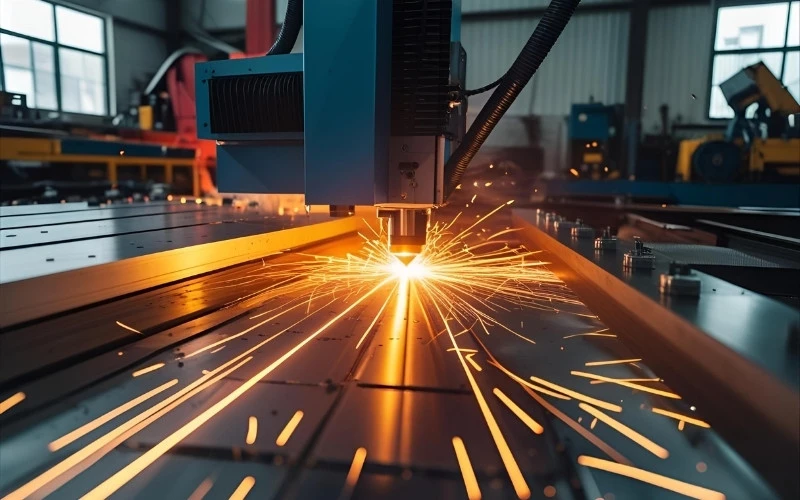
Laser cutting is a non-contact thermal manufacturing process that uses a high-power, focused laser beam to cut, engrave, or mark materials with high precision and tight tolerances, typically controlled by CAD/CAM-integrated CNC systems for automated fabrication. The process works by melting, burning, or vaporizing material with the aid of assist gases (oxygen, nitrogen, compressed air), producing clean edges, narrow kerf width, and minimal heat-affected zone (HAZ). It supports materials like metal, plastic, wood, and composites, and commonly uses fiber lasers, CO2 lasers, or Nd:YAG lasers, depending on wavelength, power output, and cutting speed, making it essential in sheet metal processing, industrial manufacturing, and precision engineering with high efficiency and low material waste.
Read more: Laser Tube Cutting: Technology, Challenges, Best Design Practices
How does the Laser Cutting Process Work?
Understanding how laser cutting works is essential if you want to evaluate its capabilities, costs, and limitations. Here’s a step-by-step breakdown:
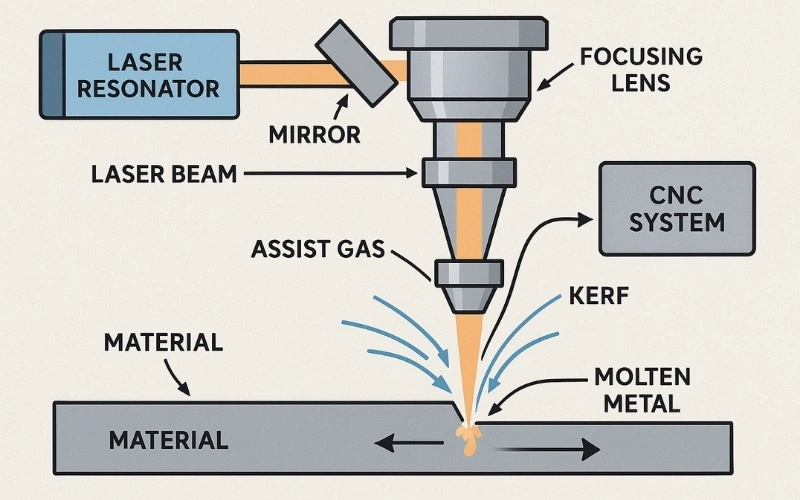
Generating the Laser Beam
The laser beam originates inside the machine’s resonator. The method of generation varies by laser type:
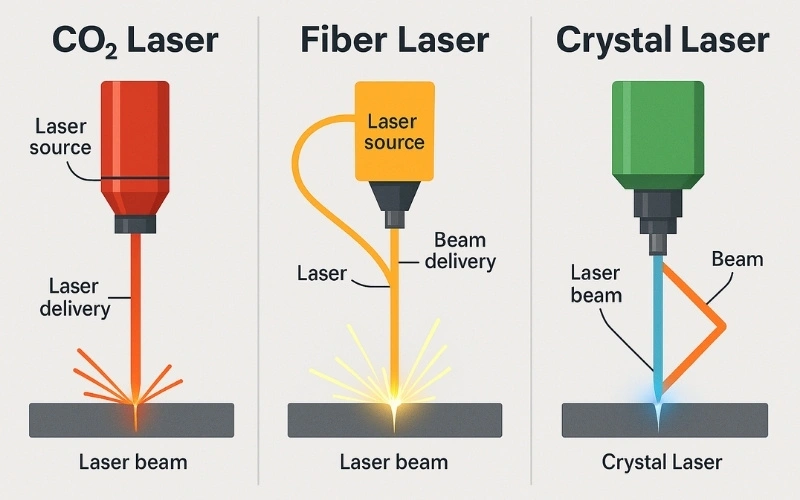
- In a CO2 laser, an electrical discharge excites a gas mixture (typically CO2, nitrogen, and helium) inside a sealed tube, causing the gas molecules to emit photons at a wavelength of 10.6 micrometers. Mirrors at each end of the tube reflect those photons back and forth, causing stimulated emission — a cascade of photons that are coherent and aligned. One mirror is partially reflective, allowing a portion of the beam to exit as the working laser.
- In a fiber laser, the process begins in a seed diode laser, and the beam is amplified as it travels through an optical fiber doped with rare-earth elements (typically ytterbium). This produces a beam at approximately 1.06 micrometers wavelength (ten times shorter than CO2), which has significant implications for how different materials absorb the energy.
Beam Delivery
Once generated, the beam must be delivered from the source to the cutting head. Fiber lasers use a flexible fiber-optic cable, while CO2 lasers rely on a series of precision mirrors.
- Fiber delivery allows the laser source to be mounted remotely and enables three-dimensional cutting with robotic arms.
- Mirror systems in CO2 machines must be perfectly aligned and kept clean — contamination as small as a fingerprint can cause beam divergence and poor cutting.
- Modern systems include protective windows and sensors that detect contamination early.
Note: A helpful practice is to schedule weekly mirror or window inspections. I once traced persistent cut quality problems on a CO2 machine to a single dirty mirror. Cleaning it improved cutting speed by 22%. Always follow the manufacturer’s alignment procedure exactly.
Focusing the Beam
The beam is focused through a lens (usually made of quartz or zinc selenide) or a specialized cutting head to achieve the extremely high power density needed to cut.
- The focal point is typically positioned on the surface or slightly below it, depending on material thickness.
- Shorter focal length lenses (3.75″ to 5″) are better for thin materials and great detail.
- Longer focal length lenses (7.5″ or 10″) are preferred for thicker materials as they provide a larger depth of field.
- Auto-focus heads now dynamically adjust focal position in real time using capacitive sensors.
Note: Incorrect focus position is one of the most common causes of poor edge quality. For mild steel thicker than 8 mm, I recommend setting the focus 10–20% of the material thickness below the surface. Test cuts on scrap material are the fastest way to dial this in.
Material Interaction
This is where laser cutting becomes genuinely interesting, and where most explanations fall short. There are three distinct physical mechanisms by which a laser removes material, and each is suited to different situations.
- Fusion cutting (melt and blow): The laser melts the material, and a high-pressure inert gas (typically nitrogen or argon) blows the molten material out of the kerf before it can resolidify or oxidize. The result is a clean, oxide-free edge with excellent surface quality. This is the preferred method for stainless steel, aluminum, and other metals where edge cleanliness matters.
- Flame cutting (reactive cutting): Here, oxygen replaces the inert gas. The oxygen reacts exothermically with the hot metal, releasing additional energy that accelerates cutting, particularly useful for thick mild steel sections. The trade-off is a visible oxide layer on the cut edge, which may require cleaning depending on the application.
- Sublimation cutting (vaporization): Some materials, especially non-metals like acrylic, wood, and fabric, can be converted directly from solid to gas by the laser without passing through a liquid phase. There is no melt to blow away, which produces exceptionally clean, often flame-polished edges. This is why laser-cut acrylic edges have that characteristic smooth, transparent quality.
| Mechanism | How It Works | Best For | Edge Quality |
| Fusion Cutting | Laser melts + inert gas ejects melt | Stainless steel, aluminum | High (oxide-free) |
| Flame Cutting | Laser + oxygen exothermic reaction | Mild/carbon steel | Medium (oxide layer present) |
| Sublimation | Material vaporizes directly | Acrylic, wood, fabric | Very high (no melt residue) |
Assisting Gas
The final stage involves the assist gas blowing the molten material out of the kerf while the surrounding area cools rapidly. This stage determines final edge quality and the size of the Heat Affected Zone.
- Nitrogen produces clean, oxide-free edges but requires much higher pressure (15–25 bar).
- Oxygen creates an exothermic reaction on carbon steels, allowing faster cutting speeds but leaving an oxidized layer.
- Efficient ejection prevents dross (resolidified material) from sticking to the bottom edge.
Note: Proper gas selection and pressure make the biggest difference in secondary processing requirements. On medical or food-grade stainless parts, we always use high-pressure nitrogen to eliminate any need for deburring or passivation. For thick mild steel where speed matters more than appearance, oxygen remains the economical choice. Always consider the downstream processes when choosing your gas type.
Types of Laser Cutting Technologies
Choosing the right laser type is not simply a matter of budget — it directly determines what materials you can process, at what speed, and with what quality. Here is what you need to know about each technology.
CO2 Laser
CO2 laser cutting has been the workhorse of industrial laser cutting since the 1970s. Operating at a 10.6 micrometer wavelength, they are exceptionally well-suited to non-metallic materials and thin-to-medium gauge metals.
Their longer wavelength is readily absorbed by organic materials — acrylic, wood, leather, fabric, rubber, and glass all cut cleanly with CO2. For metals, CO2 performs well on mild steel and stainless steel up to moderate thicknesses, but becomes less effective on highly reflective metals like raw aluminum, copper, and brass because these materials reflect rather than absorb the longer wavelength.
Typical power range: 40W (hobbyist/small format) to 6,000W+ (industrial sheet metal). Industries: signage, packaging, textiles, woodworking, electronics.
Fiber Laser
Fiber laser represents the current state of the art for metal cutting. Their 1.06-micrometer wavelength is approximately ten times shorter than CO2, and metals — including the reflective ones that frustrate CO2 systems — absorb this wavelength far more efficiently.
The practical advantages are significant. Fiber lasers cut thin metals two to three times faster than equivalent-power CO2 systems. Their wall-plug electrical efficiency is approximately 30% versus roughly 10% for CO2, making them considerably less expensive to operate. They require no mirror alignment, fewer consumables, and less maintenance overall.
For any metal cutting application — mild steel, stainless, aluminum, copper, brass, titanium — a fiber laser is almost always the technically superior choice. The trade-off is a higher initial capital cost, though this gap has narrowed substantially as fiber laser technology has matured.
Nd:YAG and Crystal Lasers
Neodymium-doped YAG (yttrium aluminum garnet) lasers also operate at approximately 1.06 micrometers and were once widely used for metal cutting. In modern industrial applications, they have largely been superseded by fiber lasers, which offer better beam quality, lower operating costs, and greater reliability. Nd:YAG retains relevance in specialized marking, engraving, and some medical applications.
Direct Diode Lasers
An emerging technology worth noting: direct diode lasers, which skip the amplification stage entirely and use the diode output directly as the working beam. These systems are becoming increasingly viable for thin sheet metal cutting and certain material processing applications. They offer excellent electrical efficiency and are expected to become more prominent in the industry over the coming decade.
| Laser Type | Wavelength | Best Materials | Cutting Speed | Initial Cost | Running Cost |
| CO2 | 10.6 μm | Non-metals, thin/medium metals | Medium | Medium | Higher |
| Fiber | 1.06 μm | All metals, reflective metals | Fast | Higher | Lower |
| Nd:YAG | 1.06 μm | Metals (niche/legacy) | Slow | Medium | Medium |
| Direct Diode | Varies | Thin sheet metal (emerging) | Medium | Decreasing | Low |
What are The Applications of Laser Cutting?
Laser cutting’s versatility means it appears across industries in ways that are not always obvious. In each case, it is not simply being used because it can cut — it is being used because it does something other processes cannot do as well.
- Aerospace and defense: Titanium brackets, aluminum structural components, and complex fuel system parts are laser cut to tight tolerances that support downstream assembly. The non-contact nature of the process means no mechanical stress is introduced to thin-walled aerospace components.
- Automotive manufacturing: Modern vehicles use high-strength low-alloy (HSLA) steels and advanced high-strength steels (AHSS) that are difficult to stamp. Laser cutting handles these materials without the tooling investment, and is used for both prototyping and production of body panels, structural components, and exhaust systems.
- Medical device manufacturing: Stents, surgical instruments, orthopedic implant components, and device enclosures are laser cut from stainless steel, titanium, and nitinol. The cleanliness and precision of the cut edge is not merely preferable; it is a patient safety requirement.
- Electronics: PCB depaneling (separating individual boards from a production panel), metal shielding components, and heat sinks are laser cut, where precision and non-contact processing prevent damage to sensitive electronic structures.
- Architecture and interior design: Decorative steel screens, custom aluminum facade panels, intricate signage, and furniture components exploit laser cutting’s ability to execute complex geometry that would be prohibitively expensive to machine or impossible to punch.
- Prototyping across all industries: Perhaps laser cutting’s most democratizing application is prototyping. A design that previously required weeks and thousands of dollars in tooling can now be cut from a digital file to a physical part in hours with no tooling cost. This has fundamentally accelerated product development cycles across manufacturing.
What Materials Are Used in Laser Cutting?
The success of any laser cutting project hinges on selecting the right material. A laser’s interaction with a material can range from a perfectly clean cut to melting, charring, or even the release of hazardous gases. This section serves as your reference guide. Below is a detailed table of common materials, their suitability for laser cutting, and crucial considerations. Most importantly, it includes materials you should NEVER attempt to cut due to extreme safety risks.
Metals
Mild and carbon steel are the most commonly laser-cut metals. It responds excellently to both CO2 and fiber lasers, and oxygen-assisted flame cutting makes it economical to process even at greater thicknesses — up to 25mm and beyond with sufficiently powerful systems.
Stainless steel is the second most common. Nitrogen-assisted fusion cutting produces bright, oxide-free edges that often require no post-processing, which is a key advantage in food service, medical, and architectural applications where edge cleanliness matters.
Aluminum is highly reflective to CO2 wavelengths, making the fiber laser the correct tool. With appropriate parameters, aluminum cuts cleanly; its tendency toward a slightly rough cut face at greater thicknesses is manageable with optimized settings.
Copper and brass are among the most challenging metals due to their very high reflectivity. High-power fiber lasers (typically 3kW and above) handle them effectively, with applications in electronics, plumbing components, and decorative work.
Titanium is one of the best-performing laser cutting materials; it cuts cleanly with excellent edge quality using nitrogen assist and is a staple in aerospace and medical device manufacturing.
Read more: What is metal laser cutting and how does it work?
Non-Metals
Acrylic (PMMA) is arguably the ideal non-metal for laser cutting. CO2 lasers produce a flame-polished edge that is optically clear straight off the machine (no sanding or polishing required). Widely used in signage, displays, and prototyping.
Wood and MDF cut cleanly with CO2 lasers, though the edges will show charring, particularly on MDF. Ventilation and filtration are essential. Suitable for furniture, decorative panels, and architectural models.
Fabric and leather are processed at high speed with CO2 lasers, and the laser simultaneously seals the edges — preventing fraying in textiles and leaving a finished edge on leather. Standard in fashion, automotive upholstery, and technical textile manufacturing.
Materials That Should Not Be Laser Cut
Some materials are unsafe or inefficient to cut:
- PVC (polyvinyl chloride): Releases chlorine gas when heated by a laser. Chlorine is toxic to operators and severely corrosive to the laser optics and machine internals. Never cut PVC.
- Polycarbonate: Cuts poorly — tends to discolor, melt unevenly, and produce poor edge quality. For transparent sheet applications, acrylic is almost always preferable.
- Fiberglass (GFRP/CFRP): The resin burns, producing toxic fumes; the glass or carbon fibers are highly abrasive and damage optics over time. Some specialized systems with appropriate extraction can handle carbon fiber, but they are not suitable for standard laser-cutting setups.
- Uncoated copper and brass with CO2 lasers: The reflectivity at CO2 wavelengths creates a risk of beam back-reflection that can damage or destroy the laser optics. Always use fiber for these materials.
Advantages and Disadvantages of Laser Cutting
Before deciding whether laser cutting is the right solution, it’s important to understand both its strengths and limitations. Evaluating these factors helps you choose the most suitable cutting method based on your specific requirements, budget, and application.
Advantages
- Unmatched Precision and Detail: Lasers can achieve incredibly high tolerances (+/- 0.1 mm or better) and cut extremely intricate and complex geometries that would be impossible with traditional cutting tools.
- High Speed and Repeatability: For many materials, especially thin sheet metal, laser cutting is exceptionally fast. As a CNC-driven process, it can also produce thousands of identical parts with perfect consistency, making it ideal for mass production.
- Non-Contact Process: The laser beam does not physically touch the material. This means there is no tool wear (unlike blades or drill bits), and it minimizes the risk of material warping or contamination, as no mechanical force is being applied.
- Incredible Material Versatility: As seen in the table above, a single laser cutting shop with both CO2 and Fiber machines can process a massive range of materials, from steel and aluminum to acrylic and wood, to leather and fabric.
- Automation and Efficiency: The process is highly automated, requiring minimal labor once a job is set up. Designs can be sent directly from a computer to the cutter, allowing for rapid prototyping and on-demand production, which reduces lead times and inventory costs.
Disadvantages
- High Upfront Equipment Cost: Industrial laser cutters are significant capital investments, often costing hundreds of thousands of dollars. This is a major barrier to entry for smaller shops and is why many businesses opt to use laser cutting services instead of purchasing a machine.
- Limitations on Material Thickness: While lasers can cut very thick materials, the process becomes much slower and less efficient as the thickness increases. For very thick plates of metal (like >25mm), other methods such as plasma or waterjet cutting are often more economical.
- Challenges with Reflective Materials: Metals like copper, brass, and polished aluminum are highly reflective. This can cause the laser beam to bounce back into the machine’s optics, potentially causing damage. It requires specialized equipment and expertise to cut these materials reliably.
- Hazardous Fumes and Safety Requirements: The vaporization of materials creates fumes and particulates that can be toxic. This necessitates a robust ventilation and filtration system. Furthermore, high-power lasers pose a severe eye and fire hazard, requiring a controlled environment and strict safety protocols.
- Heat-Affected Zone (HAZ): Because it is a thermal process, laser cutting creates a small area along the cut edge where the material’s properties have been altered by the heat. While this HAZ is typically very small, it can be a concern for certain high-stress engineering applications that require post-processing to remove it.
Key Laser Cutting Precision and Tolerances
Understanding the key parameters in laser cutting is essential for achieving high precision and consistent quality. These factors directly influence the accuracy, edge finish, and overall performance of the cutting process.
- Positional Accuracy: The precision of the laser beam positioning relative to the design directly affects dimensional accuracy.
- Kerf Width: The width of the cut; a smaller kerf improves precision and reduces material waste.
- Repeatability: The ability to consistently reproduce identical cuts across multiple runs, crucial for mass production.
- Heat-Affected Zone (HAZ): The area affected by heat around the cut; a smaller HAZ helps preserve material properties and minimize distortion.
- Surface Roughness: The smoothness of the cut edge; lower roughness results in cleaner finishes and reduces the need for post-processing.
| Parameter | Typical Range | Best-Case (High-End Systems) | Primary Influencing Factor |
| Positional Accuracy | ±0.1 – ±0.25mm | ±0.05mm | Machine quality, calibration |
| Kerf Width | 0.1 – 1.0mm | <0.1mm | Material type, power, speed |
| Repeatability | ±0.05 – ±0.1mm | ±0.02mm | CNC system, thermal stability |
| HAZ Width | 0.05 – 2.0mm | <0.1mm (fiber, high speed) | Speed, power, material type |
| Surface Roughness | Ra 1.6 – 12.5 μm | Ra 0.8 μm | Speed, assist gas, power |
Design Practices for Laser Cutting
Creating a great design for a laser cutter is about more than just drawing lines. It requires thinking like a machine. By understanding a few key concepts, you can avoid common pitfalls and ensure your parts come out perfectly, whether you’re a professional designer or a weekend hobbyist. This section is based on real-world experience.
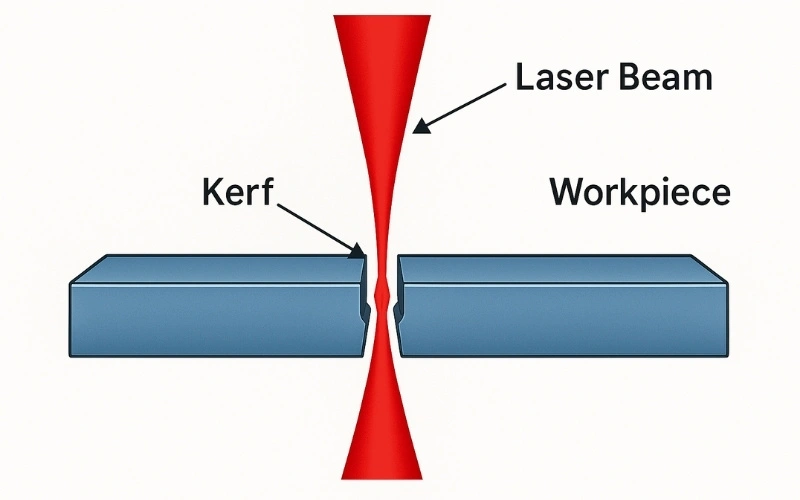
Understanding Kerf (The Laser’s Width)
The laser beam isn’t infinitely thin; it has a physical width, and the material it removes is called the kerf. This is a critical concept for any parts that need to fit together. For example, if you design a 10mm wide peg to fit into a 10mm wide hole, it won’t fit. The laser will remove a small amount of material from the edge of both parts, making the peg slightly smaller and the hole slightly larger.
Practical Tip: To compensate for kerf, you must adjust your design. A good laser cutting service will know their machine’s kerf (it’s often around 0.1mm – 0.2mm). For a snug fit, you might design the hole to be slightly smaller (e.g., 9.9mm) to account for the material that will be vaporized. Always do a small test cut with your chosen material to confirm the exact kerf before running a large job.
Vector vs Raster: Cutting vs Engraving
Your design software will use two types of imagery, and the laser interprets them differently.
- Vector: A vector is a path defined by mathematical points (like in Adobe Illustrator or AutoCAD). The laser follows this path precisely, like a knife, to cut through the material. Lines for cutting should be set to a specific, very thin stroke weight (e.g., 0.01mm or a hairline).
- Raster: A raster is a pixel-based image (like a JPEG or PNG). The laser reads this image like a printer, moving back and forth line by line and firing the laser at varying power levels to etch or engrave the surface of the material without cutting through.
File Formats and Best Practices
To ensure your design is interpreted correctly by the machine, follow these universal best practices:
- Common File Formats: DXF and DWG are the gold standards for 2D CAD. AI (Adobe Illustrator) and SVG (Scalable Vector Graphics) are also widely accepted.
- Use Closed Paths: All shapes intended for cutting must be a continuous, closed loop. If there is a tiny gap in a circle’s outline, the machine won’t know where to stop and start.
- Remove Duplicate Lines: If you have one line drawn directly on top of another, the laser will cut the same path twice. This will result in a wider kerf, a poor edge finish, and an increased fire risk.
- Convert Text to Outlines: The laser cutter’s computer won’t have your specific font installed. You must convert all text into vector shapes (an option often called “Create Outlines” or “Convert to Curves”) before saving.
Crucial Safety Precautions (YMYL Focus)
This is the most important section of this part. Lasers are powerful tools, not toys. Whether you are using a desktop machine or an industrial one, your safety and the safety of those around you are the absolute top priority. This is non-negotiable. You must remember that “Safety is paramount; always follow these rules.”:
- NEVER Leave the Laser Unattended: This is the number one rule. Materials, especially wood and acrylic, can and do catch fire. You must be present to immediately stop the machine and extinguish any flames.
- Use Proper Fume Extraction: As discussed, cutting materials creates fumes. A proper ventilation system that exhausts to the outside or a certified carbon filtration unit is mandatory to protect you from breathing in toxic and carcinogenic particles.
- Know Your Materials: Refer back to the materials table. Never guess. Cutting forbidden materials like PVC can release deadly gases and destroy your machine.
- Use Certified Laser Safety Glasses: The laser’s light, even if reflected, can cause permanent, instant blindness. You must wear safety glasses specifically rated for the wavelength of your laser (CO2 and Fiber require different glasses). Standard safety glasses offer zero protection.
- Keep a Fire Extinguisher Nearby: A CO2 fire extinguisher is essential and should be within arm’s reach of the machine at all times.
Laser Cutting vs Other Cutting Methods
Understanding laser cutting in isolation is only half the picture. The more useful question for anyone evaluating a manufacturing process is: compared to what?
Laser vs Waterjet Cutting
Waterjet cutting uses a high-pressure stream of water (often carrying abrasive particles) to erode through material. Its defining characteristic is the complete absence of heat — there is no HAZ, no thermal distortion, and no material property changes from the process.
- Choose laser when: You need speed on thin-to-medium metals, excellent edge quality, and your material is not heat-sensitive. Laser is typically faster and produces a better edge finish on metals up to 15mm.
- Choose waterjet when: You are cutting heat-sensitive materials (composites, pre-hardened steel, certain polymers), very thick sections beyond 25mm, or materials like stone, glass, or rubber that a laser cannot process effectively.
Laser vs Plasma Cutting
Plasma cutting uses a jet of ionized gas at a very high temperature to melt and blow through metal. It is fast and economical for thick carbon steel but produces a significantly larger HAZ and rougher edge quality compared to laser.
- Choose laser when: Precision and edge quality matter. Laser will outperform plasma on any metal up to approximately 20mm where tolerances are required.
- Choose plasma when: Cutting thick carbon steel (>20mm) at high volume, where precision is secondary to throughput and cost. Plasma has lower capital and operating costs for this specific use case.
Laser vs Mechanical Punching/Stamping
Punching uses hardened steel tooling to shear shapes from sheet metal at high speed. It is extremely fast for simple shapes in high volume, but every shape requires a dedicated die.
- Choose laser when: Part geometry is complex, volumes are low-to-medium, or the design changes frequently. Zero tooling cost makes lasers economically superior for custom work.
- Choose punching when: You are producing millions of identical simple shapes and already have tooling. At sufficient volume, the speed advantage of punching overcomes the laser’s tooling-cost advantage.
Laser vs EDM
Electrical Discharge Machining (EDM) uses controlled electrical sparks to erode material with extraordinary precision, achieving tolerances beyond what any laser system can match. It is also very slow and expensive.
- Choose laser when: Your tolerance requirements are ±0.1mm or coarser, and speed matters.
- Choose EDM when: You need tolerances of ±0.01mm or tighter, are working with extremely hard materials, or require complex internal 3D geometry that laser cutting physically cannot produce
Why Vietnam Is an Ideal Place for Laser Cutting
According to the latest report from ASEAN Briefing, Vietnam has become an increasingly attractive destination for laser cutting services for manufacturers seeking a balance between cost efficiency, quality, and reliability. Vietnam offers a strong combination of technical capability, competitive pricing, and a rapidly developing industrial ecosystem, making it suitable for both custom projects and large-scale production.
- Competitive manufacturing costs: Vietnam offers a significant cost advantage, with labor costs estimated to be 45–55% lower than China, while still maintaining strong productivity levels.
- High operational efficiency (not just low cost): Manufacturing facilities in Vietnam have reported Overall Equipment Effectiveness (OEE) levels of up to 85–92%, indicating efficient machine utilization and consistent output quality
- Rapid industrial growth and manufacturing expansion: Vietnam’s industrial production has shown strong momentum, with growth rates exceeding 9% in recent years, supported by increasing global demand and foreign direct investment.
- Strategic role in the “China + 1” supply chain shift: Vietnam is widely recognized as a key alternative manufacturing hub in Asia, as companies diversify production away from China to reduce risk and improve flexibility.
- Strong export capabilities and global trade access: With multiple free trade agreements (such as EVFTA and CPTPP), Vietnam enables easier access to major markets like the US and EU, reducing tariffs and improving delivery timelines.
- Growing adoption of advanced manufacturing technologies: Many Vietnamese fabrication companies are investing in modern equipment such as fiber laser cutting machines, CNC automation, and ISO-certified quality systems, enabling them to meet international standards across industries.
- Flexible production capacity: Vietnam’s manufacturing sector supports both low-volume custom fabrication and high-volume production, making it suitable for prototyping, small businesses, and large industrial buyers alike.
Choose ABC Vietnam Manufacturing as Your Best Partner
ABC Vietnam Manufacturing is a leading company offering high-quality laser cutting services in Vietnam. We specialize in laser cutting sheet and tube components (tubes, channels, angles, and structural shapes in any size and shape, using our 3D laser tube cutting machine). With over 20 years of experience in sheet metal fabrication, especially in laser cutting, combined with excellent customer support and on-time delivery, we are the most reliable company for your laser-cut projects.
- End-to-end services: Laser cutting, CNC bending, welding and finishing, helping streamline production and reduce lead times.
- Advanced equipment: Modern fiber laser systems deliver high precision, clean cuts, and consistent quality.
- Technical expertise: Experienced engineers provide support from design optimization to final production.
- Flexible production: Capable of handling both prototypes and high-volume orders.
- Quality & customer focus: Strict quality control, fast response, and tailored solutions for international clients.
- Strategic location: Competitive costs and strong export advantages from Vietnam.
Conclusion
Laser cutting has become a cornerstone of modern manufacturing thanks to its precision, flexibility, and ability to handle complex designs across a wide range of materials. From understanding how the process works to evaluating its advantages, limitations, and real-world applications, it’s clear that laser cutting offers significant value for both small-scale and industrial production. With the right parameters, technology, and manufacturing partner, businesses can achieve higher efficiency, better quality, and cost-effective results. As demand for precision engineering continues to grow, laser cutting remains a reliable solution for delivering consistent and scalable performance.
FAQs
For prototypes and medium volumes, it is usually one of the most cost-effective methods. Tooling costs are near zero compared to stamping or casting.
Modern fiber lasers routinely hold ±0.1mm in production and can achieve ±0.05mm with proper fixturing and parameter control.
You need 2D vector design software. Popular professional choices include AutoCAD (for DXF/DWG files) and Adobe Illustrator (for AI/SVG files). Free and open-source options like Inkscape (SVG) and QCAD (DXF) are also excellent and widely used by hobbyists and professionals alike.
This depends entirely on the laser’s power and the material. A low-power hobbyist CO2 laser might cut up to 6mm (1/4″) of wood. A high-power industrial fiber laser can cut through 25mm (1″) of steel or even thicker. Refer to the materials table above for general guidelines.