
Laser welding stainless steel requires precision, the correct parameters, and a thorough understanding of how the material responds to concentrated heat. Many manufacturers struggle with distortion, discoloration, or inconsistent weld strength – issues this guide is designed to solve. By breaking down the techniques, benefits, and essential considerations of laser welding stainless steel, this article helps you improve quality and efficiency while avoiding common mistakes. Keep reading to master the process with confidence.
What Is Laser Welding Stainless Steel?
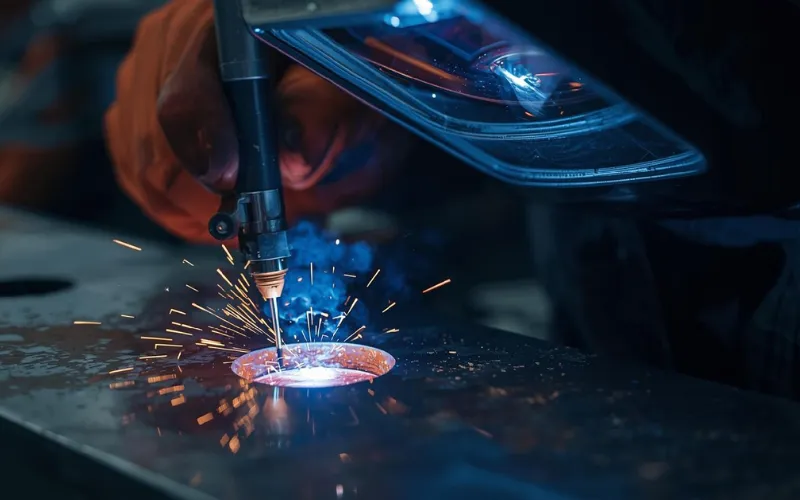
Laser welding of stainless steel is an advanced industrial fusion welding process that utilizes a high-energy-density laser beam to join stainless steel components with precise heat control. By concentrating energy into a small area, the process achieves minimal heat input, narrow heat-affected zones (HAZ), and precise weld penetration, which significantly reduces thermal distortion and ensures high dimensional accuracy. These characteristics enable high-speed, repeatable weld quality and strong automation compatibility, making laser welding widely adopted in modern manufacturing environments where production efficiency and quality-critical applications are essential.
Why Choose Laser Welding For Stainless Steel?
Laser welding is widely used for stainless steel because it combines precision, efficiency, and consistent quality in a single process. By controlling heat input and weld formation more accurately than conventional methods, it meets the demanding requirements of modern stainless steel applications. Here are some key reasons:
- High precision and accuracy: A focused laser beam allows precise control of weld size and penetration, ideal for tight-tolerance stainless steel parts.
- Low heat input: Concentrated energy creates a narrow heat-affected zone (HAZ), reducing distortion and preserving material properties.
- Fast and efficient process: High welding speeds improve productivity while limiting overall thermal impact.
- Clean weld finish: Narrow, smooth welds minimize spatter and reduce the need for post-weld finishing.
- Automation-friendly: Laser welding supports consistent, repeatable quality in automated production environments.
Which Stainless Steel Grades Can Be Laser Welded?
Not all stainless steels behave the same under laser welding conditions. Chemical composition and microstructure play a critical role in weldability.
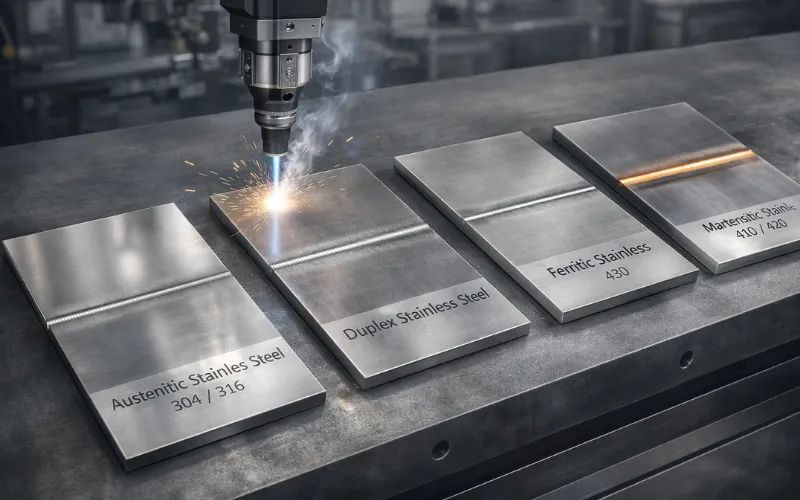
Austenitic Stainless Steel
Austenitic grades such as 304, 304L, 316, 316L, and 316Ti are the most commonly used for laser welding due to their excellent weldability and corrosion resistance.
- Superior weldability: Generally melt and fuse easily with laser energy and are less susceptible to hot cracking because of their stable face-centered cubic (FCC) structure.
- Corrosion resistance: High chromium and nickel content help preserve corrosion resistance after welding, especially with careful heat control and shielding gas.
- Common thickness range: Typical fiber laser systems handle thin to mid-thickness parts (like 0.5-4 mm) efficiently with conduction or keyhole modes.
- Application examples: Kitchenware, pharmaceutical equipment, architectural fittings, and chemical containers.
Note: Austenitic steels’ combination of ductility and corrosion resistance makes them the default choice for most general laser welding applications, especially where aesthetics and resistance to harsh environments are required.
Duplex and Super Duplex Stainless Steel
Duplex grades such as 2205 and 2507 combine features of both austenitic and ferritic steels, offering higher strength and improved corrosion resistance than standard 300-series grades.
- Balanced microstructure: Approximately equal parts ferrite and austenite give these steels superior mechanical strength, resistance to stress corrosion cracking, and good weldability when parameters are controlled.
- Phase balance sensitivity: Overheating can disturb the ferrite/austenite balance, potentially reducing toughness and corrosion resistance, so careful heat input control and shielding gas purity are critical.
- Use cases: Offshore structures, chemical processing equipment, and desalination plants.
Why this matters: Duplex steels are favored in high-performance and aggressive environments, offering long-term durability far beyond standard grades when welded correctly.
Ferritic Stainless Steel
Ferritic grades such as 409 and 430 are weldable with laser systems, but their lower nickel content and higher chromium levels change how they respond to heat.
- Moderate weldability: Lower ductility compared to austenitic grades and higher susceptibility to embrittlement or grain coarsening in the heat-affected zone.
- Heat management: Laser welding’s low heat input helps reduce typical ferritic issues (such as brittleness), but careful parameter control is still needed.
- Applications: Automotive exhaust components, appliances, decorative trims.
Remember this: Ferritic steels offer cost-effective corrosion resistance for structural parts, but welding parameters must be tailored to avoid microstructural issues.
Martensitic Stainless Steel
Martensitic grades such as 410 and 420 are harder and stronger but have higher carbon content, making them more challenging for laser welding.
- Weldability challenges: Increased risk of cracking and brittleness in the heat-affected zone without preheating or post-weld tempering.
- Heat control strategies: Preheating and controlled post-weld cooling/tempering can help manage hardness gradients and reduce cracking in the HAZ.
- Typical uses: Cutlery, high-strength tools, surgical instruments.
Note: While possible to laser weld, martensitic stainless steels require specialized thermal control and experience to avoid weld defects, so they’re generally chosen only when hardness and wear resistance are priorities.
Precipitation-Hardening Stainless Steel
Grades like 17-4PH combine high strength and corrosion resistance but depend heavily on heat treatment before and after welding.
- Heat treatment dependency: Solution-treat before welding and age after welding to restore or enhance mechanical properties.
- Applications: Aerospace parts, petrochemical shafts, high-stress components.
Why this matters: These grades are ideal when mechanical strength and corrosion resistance must be optimized post-weld, but require an integrated welding and heat-treat strategy.
Optimal Laser Welding Parameters for Stainless Steel
Understanding and controlling laser welding parameters is essential to achieve high-quality, defect-free welds in stainless steel. Below are the most important parameters that engineers and welders must control, along with practical guidelines and the latest best practices.
Power Settings by Material Thickness
A useful rule of thumb: plan for approximately 1kW of laser power per millimeter of penetration depth in keyhole mode welding. Conduction mode and partial penetration welds require less.
| Thickness | Butt joint | Lap joint | Mode |
| 0.5mm | 400-600W | 500-700W | Conduction |
| 1.0mm | 800-1000W | 1000-1200W | Transition |
| 1.5mm | 1200-1500W | 1500-1800W | Keyhole |
| 2.0mm | 1600-2000W | 2000-2400W | Keyhole |
| 3.0mm | 2500-3000W | 3000-3500W | Keyhole |
| 5.0mm+ | 4500W+ | 5000W+ | Keyhole |
Note: Values for austenitic grades with fiber laser. Adjust ±10-15% for ferritic or duplex grades.
Welding Speed
Speed and power work together to control heat input. Higher speeds with proportionally higher power maintain penetration while reducing total heat input – beneficial for distortion control. Visual indicators help dial in optimal speed:
- Too fast: Narrow, peaked bead; possible undercut; incomplete penetration.
- Optimal: Consistent width; slight ripple pattern; good fusion at root.
- Too slow: Wide, sunken bead; excessive spatter; possible burn-through.
Note: For 1.0mm 304 stainless with 1,000W power, expect optimal speeds around 25-35mm/s. Thicker materials require slower speeds; 3.0mm might weld at 10-15mm/s with appropriate power.
Best practices
- Start with manufacturer-recommended speed ranges.
- Adjust speed in small increments while observing weld bead quality.
- A balanced speed reduces HAZ and improves bead profile uniformity.
Shielding Gas Type and Flow Rate
Shielding gas protects the molten weld pool from atmospheric contamination. For stainless steel, proper shielding is non-negotiable – inadequate coverage causes oxidation that compromises corrosion resistance and mechanical properties.
| Gas | Application | Flow rate | Note |
| 100% Argon | General purpose | 15-25L/min | Most economical, excellent protection |
| Argon + 25-50% Helium | Deep penetration | 20-30L/min | Helium increases penetration; higher cost |
| Argon + 2-3% Nitrogen | Duplex grades | 15-25L/min | Maintains weld nitrogen content |
Remember this: Deliver shielding gas coaxially through the welding head for most applications. Critical welds may require trailing shields (protecting the cooling weld) and backing gas (protecting the root side).
Common Defects in Laser Welding Stainless Steel and How to Prevent Them
Even with advanced laser systems, defects can occur if process parameters, material condition, or joint preparation are not properly controlled. Understanding the root causes of each defect is the most effective way to prevent them in real production.
Porosity
Porosity appears as small gas pockets trapped inside the weld metal and is one of the most common defects in laser welding stainless steel.
Main causes:
- Surface contamination (oil, moisture, oxides).
- Unstable keyhole due to incorrect power or speed.
- Inadequate shielding gas coverage.
Prevention methods:
- Thoroughly clean joint surfaces before welding.
- Stabilize the keyhole by optimizing laser power and welding speed.
- Ensure consistent and sufficient shielding gas flow aligned with the weld zone.
Cracking (Hot Cracking or Solidification Cracking)
Cracking can occur during solidification, especially in certain stainless steel grades.
Main causes:
- High cooling rates combined with a susceptible alloy composition.
- Excessive weld penetration and restraint.
- Improper heat input control.
How to prevent:
- Optimize heat input to avoid excessive penetration.
- Use a suitable joint design to reduce restraint.
- For crack-sensitive grades, consider controlled cooling or metallurgical evaluation.
Lack of Fusion
Lack of fusion occurs when the weld metal does not fully bond with the base material or joint edges.
Main causes:
- Insufficient laser power.
- Excessive welding speed.
- Incorrect focus position.
Prevention methods:
- Increase laser power within a stable operating range.
- Reduce welding speed slightly to increase energy input.
- Adjust focus position to ensure optimal energy density at the joint interface.
Excessive Spatter and Keyhole Instability
Spatter and unstable weld pools reduce weld quality and surface appearance.
Main causes:
- Excessively high laser power.
- Poor beam focus or unstable power delivery.
- Inconsistent joint fit-up.
How to prevent:
- Reduce laser power or adjust focus offset.
- Maintain stable beam quality and power output.
- Improve joint preparation and fixturing consistency.
Oxidation and Surface Discoloration
Oxidation leads to discoloration (blue, brown, or black marks) and can reduce corrosion resistance.
Main causes:
- Inadequate shielding gas coverage.
- Incorrect gas type or flow rate.
- Turbulent gas flow around the weld pool.
Prevention methods:
- Use appropriate shielding gas (commonly argon or nitrogen).
- Optimize gas flow rate to fully cover the molten pool.
- Improve nozzle design and positioning to avoid turbulence.
Excessive Distortion or Warping
Although laser welding minimizes heat input, distortion can still occur in thin or poorly supported parts.
Main causes:
- Excessive heat input.
- Poor fixturing or uneven clamping.
- Incorrect welding sequence.
How to prevent:
- Increase welding speed while maintaining penetration.
- Use proper fixturing to support the workpiece.
- Optimize welding sequence to balance heat distribution.
Conclusion
Laser welding is one of the most efficient, precise, and advanced methods for joining stainless steel. When executed with proper technique, correct parameters, and careful preparation, it delivers superior strength, minimal distortion, and a flawless finish. Whether for industrial mass production or high-precision applications, laser welding continues to set the standard for stainless steel fabrication.
FAQs
Yes, most stainless steel grades can be laser-welded efficiently.
Laser welding is best for 0.2 mm–6 mm thickness, depending on power.
Usually not, except for certain martensitic or duplex grades.