
Choosing between laser tube cutting and saw tube cutting can directly impact your production cost, precision, and scalability. Many manufacturers struggle with unclear tolerance differences, hidden secondary processing costs, and conflicting advice online. This laser tube cutting vs saw tube cutting guide breaks down real engineering data, cost comparisons, and application scenarios so you can make a confident, performance-driven decision.
What Is Laser and Saw Tube Cutting?
Before comparing performance, cost, and precision, it’s important to clearly understand how each cutting method works. While both processes are used to cut metal tubing, their technology, capabilities, and production impact differ significantly.
Laser Tube Cutting
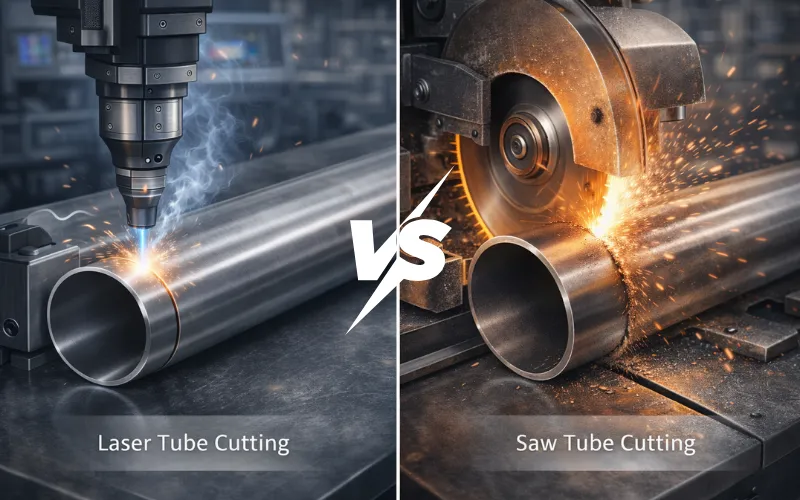
Laser tube cutting is a CNC-controlled process that uses a high-powered fiber laser beam to cut metal tubes with extreme precision. The tube rotates while the laser head moves along programmed axes, allowing complex cutting operations in a single setup. Key characteristics and advantages:
- Enables straight cuts, slots, holes, notches, and complex contours
- Delivers tight tolerances (typically ±0.05–0.10 mm)
- Produces minimal burr formation
- Ensures high repeatability
- Suitable for stainless steel, carbon steel, and aluminum tubing
- Ideal for industries requiring high precision and automation
- Reduces the need for secondary processing
- Highly efficient for medium- to high-volume production
- Well-suited for geometry-intensive parts
Saw Tube Cutting
Saw tube cutting is a mechanical process that uses a rotating blade (commonly a cold saw or band saw) to cut through metal tubes. During the process, the tube is clamped in place while the blade performs a straight cut across the material. Key characteristics and limitations:
- Typical tolerances range from ±0.20–0.50 mm (depending on blade condition and machine stability)
- Burr formation is common and often requires deburring or finishing
- Best suited for simple, straight cuts
- Ideal for low-volume production
- Commonly used in structural applications where tight tolerances and complex geometries are not required
Direct Technical Comparison
Now that we understand how each process works, let’s compare laser and saw tube cutting from a practical engineering perspective. The differences become clear when we evaluate accuracy, speed, cost structure, and overall production efficiency side by side.
Cutting Accuracy And Tolerance
Laser systems consistently maintain tolerances of ±0.05–0.10 mm over long production runs, thanks to CNC motion control, servo-driven tube rotation, and real-time position feedback. On modern fiber laser tube machines, repeatability can reach as tight as ±0.02–0.05 mm. Beyond linear tolerance, laser cutting also maintains:
- More consistent squareness of cut faces
- Better concentric alignment on round tubes
- Reduced dimensional variation between batches
In contrast, saw cutting typically achieves tolerances of ±0.20–0.50 mm. Accuracy depends on factors such as blade sharpness, feed rate, clamping rigidity, vibration control, and operator consistency. Over time, tolerances may drift as blades wear down or as the material shifts during mechanical cutting.
Why this matters:
- Precision assemblies require a tight fit-up.
- Poor tolerance increases welding distortion.
- In robotic welding, deviation >0.2 mm can cause alignment failure.
For structural or mechanical assemblies requiring consistent alignment, repeatability, and reduced rework, laser cutting provides measurable accuracy advantages over saw cutting (particularly in medium to high-volume production environments).
Cutting Speed And Production Efficiency
Production speed isn’t just raw cut time; it includes setup, programming, material handling, and uptime. With laser tube cutting, its systems shine in throughput because:
- One setup can produce complex contours, slots, and straight cuts.
- Nested CNC programs maximize material utilization.
- Automatic loading/unloading reduces idle time.
- Real-time monitoring and predictive maintenance software minimize unplanned stoppages.
Cut speed varies by material and thickness, but in typical mild steel tubing (below 6 mm wall), lasers consistently outperform saws on throughput per hour – often by 2–3× in medium-to-high volume.
On the other hand, saw operations generally have slower cutting cycles and higher manual intervention:
- Blade changes
- Manual material restacking
- Periodic alignment checks
- Deburring preparation
For short, straight cuts, saws remain straightforward. But as geometry complexity and batch size grow, laser systems amortize time savings quickly.
Edge Quality And Secondary Processing
Edge condition directly affects welding quality, coating adhesion, assembly fit, and total labor cost. Below is a side-by-side comparison of laser and saw tube cutting in terms of edge performance and downstream processing impact.
| Laser Tube Cutting | Saw Tube Cutting | |
| Burr Formation | Minimal to none in most applications | Common, especially on exit side |
| Surface Finish | Smooth, narrow kerf | Rougher due to mechanical tooth marks |
| Heat-Affected Zone (HAZ) | Small and controlled | Common, especially on the exit side |
| Edge Squareness | Highly consistent with CNC control | Depends on blade condition and clamping stability |
| Oxidation | Minimal with nitrogen assist gas | None from heat, but exposed raw edge |
| Need for Deburring | Rarely required | Frequently required |
| Welding Readiness | Often weld-ready without grinding | Typically requires cleaning or deburring |
| Coating / Painting Prep | Good adhesion due to clean edge | May require edge preparation |
| Consistency Over Long Runs | Stable and repeatable | Edge quality declines as blade wears |
| Impact on Secondary Labor | Low | Moderate to high |
Production impact: Laser cutting minimizes rework, stabilizes weld preparation, and reduces manual finishing time. Saw cutting may appear simple initially, but it often introduces additional downstream labor that increases total production cost and variability.
Cost Comparison
Many decision-makers focus only on the machine purchase price. That approach ignores operational efficiency, labor, consumables, scrap rate, and long-term scalability.
Capital Investment
Laser systems require significant upfront investment, but consumable costs are lower because there are no mechanical blades to replace. Saw cutting has a lower entry cost, but recurring blade expenses increase operational cost over time.
| Laser | Saw | |
| Machine Cost | High | Low |
| Tooling Cost | Minimal (no blade wear) | Recurring blade replacement |
| Maintenance | Moderate (optics, alignment, assist gas) | Moderate (blade, coolant, alignment) |
| Labor | Low (automation capable) | Higher (manual handling) |
| Floor Space Efficiency | High (integrated systems) | Moderate |
Cost per Part (Estimated)
- At 500 parts: Saw is typically cheaper due to lower setup amortization.
- At 5,000+ parts: Laser often becomes more economical due to faster cycle time, lower labor input, and minimal finishing.
- At 10,000+ parts or recurring production, Laser provides a substantial cost advantage due to automation and reduced scrap rate.
Break-Even Analysis
For medium production runs (~3,000–5,000 units), the higher capital cost of the laser begins to amortize effectively. The break-even point depends on:
- Labor cost per hour
- Complexity of geometry
- Secondary processing requirements
- Production frequency (one-time vs recurring)
Key insight: Laser is not inherently expensive; it is capital-intensive. Over time and repeated production cycles, it becomes cost-efficient and operationally stable.
Material And Thickness Capability
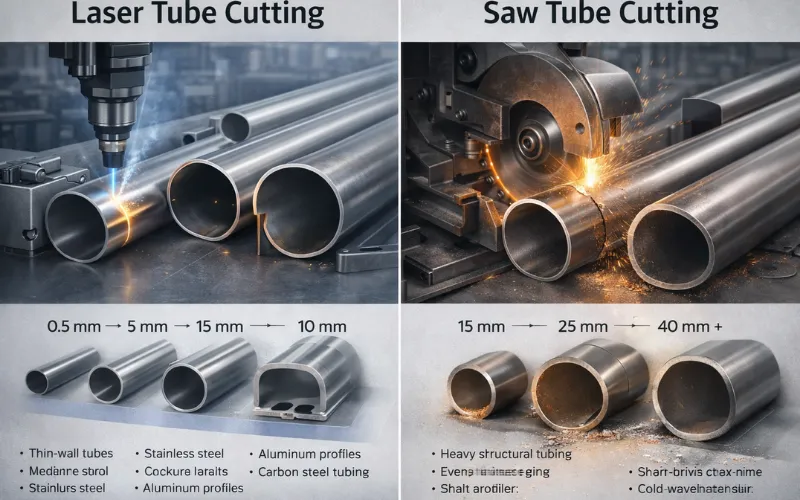
Laser cutting works best within optimized wall thickness ranges. Extremely thick structural tubing (>20mm wall) may still favor mechanical cutting.
Laser cutting performs well in:
- Thin to medium wall tubing (0.5–20 mm typical industrial range)
- Stainless steel (clean edge, low oxidation with nitrogen assist)
- Aluminum profiles (with proper wavelength control)
- Carbon steel structural tubing
- Decorative or exposed architectural tubing
- Complex-shaped tubes requiring slots or contour features
Saw cutting is suitable for:
- Very thick walls and heavy structural members
- Basic construction tubing with loose tolerance requirements
- Short-run fabrication jobs
- Situations where thermal effects must be avoided entirely
When Should You Choose Laser or Saw Tube Cutting?
Selecting between laser tube cutting and saw tube cutting depends on technical requirements, production scale, cost structure, and downstream workflow efficiency.
Choose laser tube cutting when you:
- Require complex geometries such as slots, coping joints, miters, bevels, and intricate contours in round or square tubes.
- Need high precision and tight tolerances with consistent repeatability across large production runs.
- Want to reduce or eliminate secondary processing like deburring and grinding.
- Prioritize automated production lines and Industry 4.0 integration.
- Aim to optimize material utilization through advanced nesting software.
- Manufacture high-value components for industries such as automotive, aerospace, medical, or architectural fabrication.
Choose saw tube cutting when you:
- Only need simple, straight 90-degree cuts without complex profiles.
- Require lower initial equipment investment and reduced capital cost.
- Operate small-batch, project-based, or workshop-level production.
- Cut thick-wall tubes where extreme precision is not critical.
- Must completely avoid heat-affected zones during the cutting process.
Case Study: Laser vs Saw in 5,000-Part Production
In order to help you understand more clearly, please read an example of the agricultural frame tubing project that we have done. The material we use in this project is ASTM A500 Grade B, the tube is 60mm OD, 4mm wall, and the quantity is 5,000 parts. The cut type we choose is straight structural cuts for frame assembly.
| Laser | Saw | |
| Total Production Time | 7 hours | 21 hours |
| Deburring Required | No secondary deburring required; edges are clean and weld-ready | 2 operators are typically required for cutting and finishing |
| Dimensional Consistency | ±0.1–0.2 mm tolerance maintained consistently across full batch | ±0.3–0.5 mm variation depending on blade wear and clamping stability |
| Labor Requirement | Additional grinding and edge cleaning are needed before welding | Yes, manual or mechanical deburring is required to remove exit burrs |
| Scrap Rate | <1% due to CNC length control and optimized material usage | 3–5% due to cut variation, rework, and off-length trimming |
| Welding Preparation | Parts can move directly to welding with minimal edge prep | Additional grinding and edge cleaning needed before welding |
| Total Project Cost | Lower at production scale | Higher |
For structural tubing in medium-to-high volume production, total manufacturing efficiency (not just equipment price) determines profitability. In this case, laser cutting delivers faster throughput, more stable quality control, and measurable cost savings (reduced by nearly 18%) without requiring additional finishing processes.
Conclusion
In summary, the choice between laser tube cutting and saw tube cutting should align with your production goals, technical requirements, and long-term cost strategy. By understanding how each method impacts accuracy, efficiency, secondary processing, and scalability, you can make a decision that supports both current project demands and future growth. Selecting the right cutting solution is not just about equipment – it is about optimizing your entire manufacturing workflow.
FAQs
Not at all. The hourly rate of a tube laser is usually higher, but once you factor in saved drilling, coping, deburring, and faster assembly, the total cost per part can be lower for many designs.
Laser cutting produces significantly less burr and often requires no deburring.
For very simple tubes, saws are usually cheaper for one-offs. But if the prototype has complex geometry or is meant to validate a production design, tube laser cutting saves time and better reflects real production conditions.